Blog Feed

What is a Thread?

About Threads in Operating System

 A thread of execution is the smallest sequence of programmed instructions that can be managed independently by a scheduler, which is typically a part of the operating system. The implementation of threads and processes differs between operating systems, but in most cases a thread is a component of a process. Multiple threads can exist within one process, executing concurrently and sharing resources such as memory, while different processes do not share these resources. In particular, the threads of a process share its executable code and the values of its dynamically allocated variables and non-thread-local-global variables at any given time.

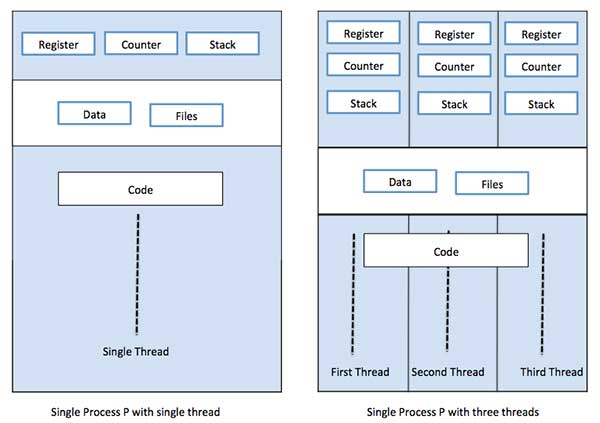
A thread is a flow of execution through the process code, with its own program counter that keeps track of which instruction to execute next, system registers which hold its current working variables, and a stack which contains the execution history.

A thread shares with its peer threads few information like code segment, data segment and open files. When one thread alters a code segment memory item, all other threads see that.

A thread is also called a lightweight process. Threads provide a way to improve application performance through parallelism. Threads represent a software approach to improving performance of operating system by reducing the overhead thread is equivalent to a classical process.

Each thread belongs to exactly one process and no thread can exist outside a process. Each thread represents a separate flow of control. Threads have been successfully used in implementing network servers and web server. They also provide a suitable foundation for parallel execution of applications on shared memory multiprocessors. The following figure shows the working of a single-threaded and a multithreaded process.

Types of Thread

User Level Threads

In this case, the thread management kernel is not aware of the existence of threads. The thread library contains code for creating and destroying threads, for passing message and data between threads, for scheduling thread execution and for saving and restoring thread contexts. The application starts with a single thread.

Advantages

  • Thread switching does not require Kernel mode privileges.
  • User level thread can run on any operating system.
  • Scheduling can be application specific in the user level thread.
  • User level threads are fast to create and manage.

Disadvantages

  • In a typical operating system, most system calls are blocking.
  • Multithreaded application cannot take advantage of multiprocessing.

Kernel Level Threads

In this case, thread management is done by the Kernel. There is no thread management code in the application area. Kernel threads are supported directly by the operating system. Any application can be programmed to be multithreaded. All of the threads within an application are supported within a single process.

The Kernel maintains context information for the process as a whole and for individuals threads within the process. Scheduling by the Kernel is done on a thread basis. The Kernel performs thread creation, scheduling and management in Kernel space. Kernel threads are generally slower to create and manage than the user threads.

Advantages

  • Kernel can simultaneously schedule multiple threads from the same process on multiple processes.
  • If one thread in a process is blocked, the Kernel can schedule another thread of the same process.
  • Kernel routines themselves can be multithreaded.

Disadvantages

  • Kernel threads are generally slower to create and manage than the user threads.
  • Transfer of control from one thread to another within the same process requires a mode switch to the Kernel.

Difference between User-Level & Kernel-Level Thread

S.N.User-Level ThreadsKernel-Level Thread
1User-level threads are faster to create and manage.Kernel-level threads are slower to create and manage.
2Implementation is by a thread library at the user level.Operating system supports creation of Kernel threads.
3User-level thread is generic and can run on any operating system.Kernel-level thread is specific to the operating system.
4Multi-threaded applications cannot take advantage of multiprocessing.Kernel routines themselves can be multithreaded.

Multi Threading Models in Process Management

Many to Many Model

In this model, we have multiple user threads multiplex to same or lesser number of kernel level threads. Number of kernel level threads are specific to the machine, advantage of this model is if a user thread is blocked we can schedule others user thread to other kernel thread. Thus, System doesn’t block if a particular thread is blocked.

Many to One Model

In this model, we have multiple user threads mapped to one kernel thread. In this model when a user thread makes a blocking system call entire process blocks. As we have only one kernel thread and only one user thread can access kernel at a time, so multiple threads are not able access multiprocessor at the same time.

One to One Model


In this model, one to one relationship between kernel and user thread. In this model multiple thread can run on multiple processor. Problem with this model is that creating a user thread requires the corresponding kernel thread.

Difference between User Level thread and Kernel Level thread

USER LEVEL THREADKERNEL LEVEL THREAD
User thread are implemented by users.kernel threads are implemented by OS.
OS doesn’t recognized user level threads.Kernel threads are recognized by OS.
Implementation of User threads is easy.Implementation of Kernel thread is complicated.
Context switch time is less.Context switch time is more.
Context switch requires no hardware support.Hardware support is needed.
If one user level thread perform blocking operation then entire process will be blocked.If one kernel thread perform blocking operation then another thread can continue execution.
Example : Java thread, POSIX threads.Example : Window Solaris.

Threads vs. processes

  • processes are typically independent, while threads exist as subsets of a process
  • processes carry considerably more state information than threads, whereas multiple threads within a process share process state as well as memory and other resources
  • processes have separate address spaces, whereas threads share their address space
  • processes interact only through system-provided inter-process communication mechanisms
  • context switching between threads in the same process typically occurs faster than context switching between processes

History

Threads made an early appearance under the name of “tasks” in OS/360 Multiprogramming with a Variable Number of Tasks (MVT) in 1967. Saltzer (1966) credits Victor A. Vyssotsky with the term “thread”. The process schedulers of many modern operating systems directly support both time-sliced and multiprocessor threading, and the operating system kernel allows programmers to manipulate threads by exposing required functionality through the system-call interface. Some threading implementations are called kernel threads, whereas light-weight processes (LWP) are a specific type of kernel thread that share the same state and information. Furthermore, programs can have user-space threads when threading with timers, signals, or other methods to interrupt their own execution, performing a sort of ad hoc time-slicing.